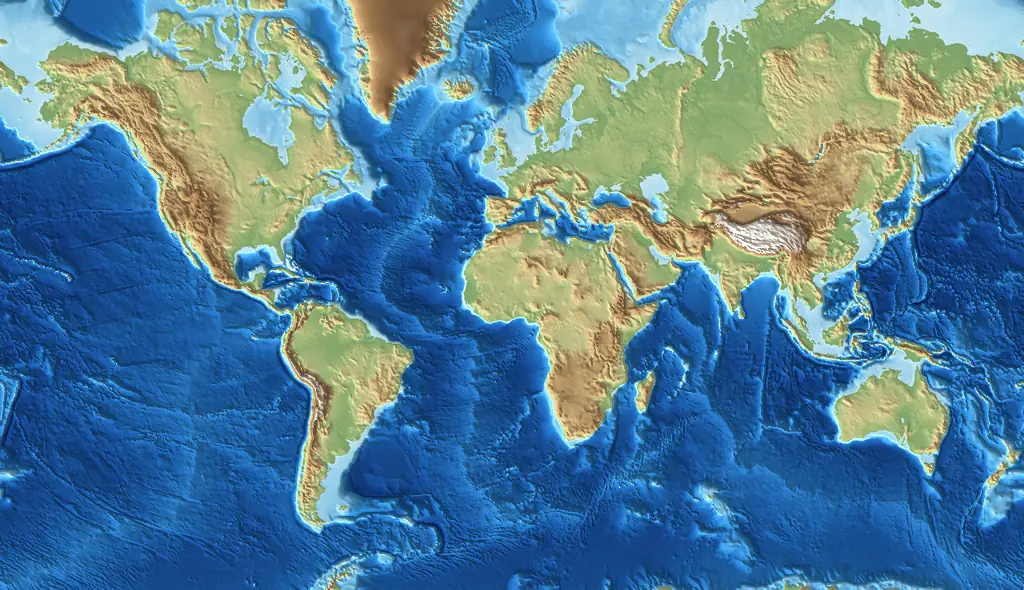
Pacific Ocean at a glance
- 4,315 maverage depth
- 4,422 mmedian depth
- 10,927 mmaximum depth
- 139.1 million km²water area
Pacific Ocean is one of the world's five oceans. Inside its outline the GEBCO grid has about 139.1 million km² of water, with an average depth of about 4,315 m (the middle value is 4,422 m) and a maximum of 10,927 m, found at 11.37° N, 142.60° E.
Open the map at the deepest cell and tap to read the depth.
How deep is each part of the Pacific Ocean?
The bar splits the Pacific Ocean's water by depth. Each colour is a depth band, and the shares add up to 100%.
- 0 to 200 m: 0.7%
- 200 to 1,000 m: 1.1%
- 1,000 to 4,000 m: 32.7%
- 4,000 to 6,000 m: 63.8%
- below 6,000 m: 1.8%
Named features near the deepest point: Challenger Deep (1 km), Vityas Deep 1 (38 km), Mariana Trench (43 km), Sirena Deep (229 km).
Philippine Sea lists 10,931 m, more than the 10,927 m here, because the sea and ocean outlines overlap and are drawn separately.
The Pacific Ocean if sea level dropped
The slider on the map lowers the sea in steps. This table shows how much of the Pacific Ocean's water would be land at each step.
| Sea level lowered by | Becomes land | Share of its water |
|---|---|---|
| 10 m | 59,692 km² | under 0.1% |
| 20 m | 122,201 km² | under 0.1% |
| 50 m | 293,296 km² | 0.2% |
| 80 m | 448,900 km² | 0.3% |
| 120 m | 653,533 km² | 0.5% |
| 200 m | 935,284 km² | 0.7% |
| 500 m | 1.4 million km² | 1% |
| 1,000 m | 2.4 million km² | 1.7% |
| 2,000 m | 5.8 million km² | 4.1% |
| 3,000 m | 14.3 million km² | 10.3% |
| 4,000 m | 47.8 million km² | 34.4% |
| 6,000 m | 136.7 million km² | 98.2% |
A simple bathtub model: it lowers the sea everywhere by the same amount and does not simulate how water would really drain.
The biggest seas
- Philippine Sea 5.6 million km², up to 10,931 m
- Arabian Sea 4.1 million km², up to 9,536 m
- Coral Sea 4 million km², up to 9,142 m
- Tasman Sea 3.3 million km², up to 6,281 m
- South China Sea 3.1 million km², up to 5,232 m
- Sargasso Sea 3 million km², up to 7,761 m
- Caribbean Sea 2.8 million km², up to 8,293 m
- Bering Sea 2.2 million km², up to 7,043 m
- Mediterranean Sea 1.6 million km², up to 5,030 m
- Norwegian Sea 1.5 million km², up to 4,057 m
Seas lie inside or beside the oceans, so their areas overlap with the ocean figures. All oceans and seas
Frequently asked questions
How deep is the Pacific Ocean?
On average about 4,315 m in the GEBCO grid (the middle value is 4,422 m). The deepest cell inside its outline is 10,927 m, at 11.37° N, 142.60° E.
How big is the Pacific Ocean?
About 139.1 million km² of water inside its Natural Earth outline, counted from the grid cells that are below sea level. Marginal seas lie inside the ocean outlines, so the areas of the oceans and seas overlap and should not be added together.
How much of the Pacific Ocean would be land if sea level dropped?
With the sea 500 m lower, about 1.4 million km² (1%) of its water would be land. At 6,000 m lower, 98.2% would be. This is a simple bathtub model that lowers the sea evenly everywhere.
Data: depths from the GEBCO_2026 grid, statistics worked out inside the Natural Earth outline of the ocean. See data sources and licences. The GEBCO Grid should NOT be used for navigation or for any other purpose involving safety at sea.